What actually happens when you open Tomus
No trailer, no promises about rewiring your brain. Here is the structure of the app, game by game.
A session, start to finish
You answer a few questions before you start
The first run asks which of the five areas you care about and gives you a short test in each. That sets your starting level rather than dropping everyone at the beginning.
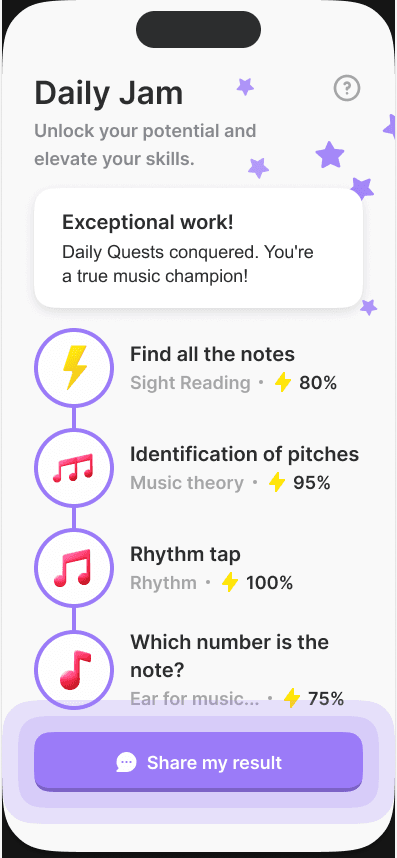
You take the Daily Jam, or pick a game
The Daily Jam is a prepared set for that day, drawn from ear training, sight-reading and rhythm. Otherwise you choose from the game grid.
You answer around ten questions
A timer runs and you have a small number of lives. Questions are multiple choice, tap-to-match, or listen-and-identify depending on the game.
Each answer is corrected immediately
You are shown the correct answer, and written questions carry an explanation. You can review the whole run afterwards, question by question.
The run ends with a summary
Correct, incorrect, accuracy and elapsed time, plus your progress across the five areas and your daily streak.
The 26 games
Five areas. The reading, listening and rhythm games generate their questions, so they do not run out; the theory and outlook games draw on a bank of about 2,441 written questions, each with an explanation attached.
Sight reading
Generated exercisesNotes on the stave, named against a timer. Treble clef to begin with; bass clef arrives as you progress, and the range widens with it.
- Guess the Solo NoteName a single note on the stave.
- Spot the Note in OrderFind one note within a sequence.Unlocks at Apprentice
- Notes Mix-Up ChallengeSeveral notes at once.Unlocks at Composer
- YES / NO Note QuestionsFast true-or-false reading.Unlocks at Journeyman
Ear training
Generated exercisesThe same questions as sight-reading, but played rather than shown. You identify what you heard.
- Hear the Solo NoteIdentify a single pitch by ear.
- Melodic Order ChallengeFollow a short sequence.Unlocks at Apprentice
- Audio Mix-Up ChallengeSeveral pitches at once.Unlocks at Composer
- YES / NO Audio QuestionsFast listening decisions.Unlocks at Journeyman
Rhythm
Generated exercisesNote values, rests and time signatures — read, matched and completed. Covers whole through sixteenth notes in 2/4, 3/4, 4/4 and 6/8.
- Note Length DetectiveName the note value.
- Guess the RestName the rest.
- Fill the BeatComplete a bar correctly.Unlocks at Apprentice
- Beat the BarMatch a rhythm sequence.Unlocks at Apprentice
- Signature SeekerIdentify the time signature.Unlocks at Soloist
Music theory
From the question bankWritten theory questions with an explanation attached to every answer.
- Pitches
- Intervals
- Scales
- Chords
- Key Signatures
Music outlook
From the question bankThe context around the notation: who wrote what, which instrument is which, and where a piece sits in history. This is where most of the curated question bank lives.
- Composers
- Instruments
- Music history
- Music genre
- Music records
- Music Faces
- Classical compositions
- Christmas carolsSeasonal in subject, but listed all year.
A Christmas carols game also appears seasonally.
Progression is not decoration
There are 10 levels, from Novice to Legend, and they change what you are shown rather than just awarding a badge.
- Reading games start in treble clef only. Bass clef arrives a few levels in, once the treble notes are reliable.
- The range of notes widens level by level, starting from a single octave.
- Several games are locked until you reach the level they are written for.
What you get without paying
The app is free to download, and 3 of the day’s 5 Daily Jam exercises are playable without a subscription, every day. A premium subscription unlocks the remaining two and the rest of the library.
That is enough for a daily habit without paying anything. See the FAQ for current prices.
What Tomus does not do
- It does not teach you to play an instrument, and it does not listen to you play one.
- It is not a course. There is no syllabus that ends with a certificate.
- It does not teach concepts from scratch — that is what the free Learn section on this site is for.
- There is no Android or web version.
The facts
- Platform
- iPhone and iPad
- Minimum OS
- iOS 15.0
- Price
- Free to download
- Games
- 26 across 5 areas
- Question bank
- ~2,441 written questions
- Rating
- 4.9 from 52 ratings
- First released
- July 2023
Game and content figures are taken from the shipped app; rating from the US App Store, September 2026.