Roundup
The best ear training apps
Eleven apps for training relative pitch, sorted by what kind of listening they actually train.
Ear training is the slowest-moving skill in music and the one with the highest payoff. It is also the one where app practice most closely resembles the real thing: hear something, name it, find out immediately whether you were right.
How these are ranked
Four criteria, in this order:
- Breadth — intervals, chords, scales, progressions, rhythm, or only some of those.
- Method — whether it trains notes in isolation or in a key context.
- Feedback quality — how quickly and clearly you learn you were wrong.
- Maintenance — a dormant app is a liability whatever it once did.
Price is not a ranking criterion here: almost everything on this list is free or a few dollars.
Two kinds of ear training
Worth knowing before you choose, because the apps split along this line.
Interval-based. Play two notes, name the distance. This is the classic approach and the one most apps use. It builds precise recognition but can leave you naming intervals in a vacuum.
Functional. Play a key context first, then a note, and name the note's role in that key — the third, the fifth, the leading tone. This is closer to how listening actually works in music, and many people find it transfers faster.
Most players benefit from both. Start with whichever holds your attention.
The short version

Earpeggio
4.9Free
- Best for
- Almost anyone. The safe first pick.
- Watch out for
- Paid tier for the deeper material

Functional Ear Trainer
4.9Free
- Best for
- Hearing notes in a key rather than in isolation
- Watch out for
- No chord or progression work

Chet
4.8Free
- Best for
- A modern, well-designed all-rounder
- Watch out for
- Newer, so a smaller track record

Perfect Ear
4.7Free
- Best for
- Breadth — intervals, chords, rhythm and theory in one
- Watch out for
- Interface is dense

Tomus
4.9Free
- Best for
- Ear training as one part of general musicianship
- Watch out for
- Not a deep, configurable ear trainer

Sonofield Ear Trainer
4.9Free
- Best for
- Careful, methodical practice
- Watch out for
- Small user base so far

Tenuto
4.8$4.99
- Best for
- Drilling alongside musictheory.net's lessons
- Watch out for
- Paid up front; no functional mode

EarMaster
4.6Free
- Best for
- A structured course with a syllabus
- Watch out for
- Heaviest of the group

Complete Ear Trainer
4.7Free
- Best for
- A large exercise bank at no cost
- Watch out for
- Dated interface

MyEarTraining
4.8Free
- Best for
- Fine-grained control over exactly what you drill
- Watch out for
- Quiet since May 2025

Duolingo
4.7Free
- Best for
- A first habit, if nothing else has stuck
- Watch out for
- Narrowest ear work here, and it corrects without explaining
1. Earpeggio
Earpeggio
by Balazs Kiss
4.9 from 9,617 ratingsFreeActively updated
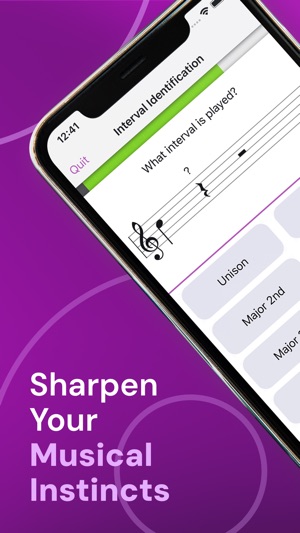
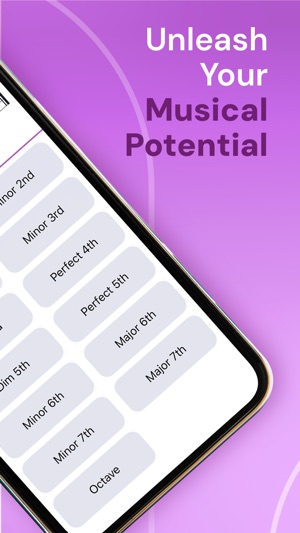
The most polished ear trainer on iOS and the highest-rated at meaningful scale. Covers intervals, chords, progressions and scales, with a well-judged difficulty ramp and clear statistics.
Good for: almost anyone. This is the safe first recommendation.
2. Functional Ear Trainer
Functional Ear Trainer
by Serhii Korchan
4.9 from 3,743 ratingsFreeActively updated
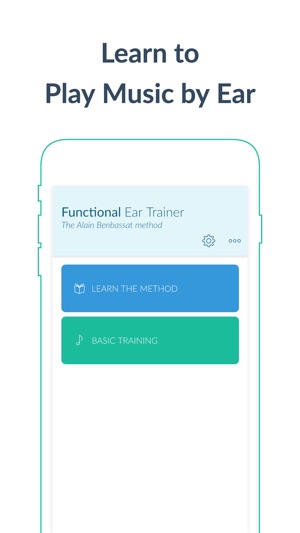
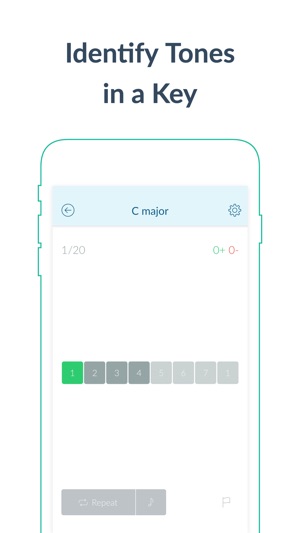
The reference implementation of the functional approach: a cadence establishes the key, then a note plays and you name its scale degree. Deceptively simple and extremely effective.
Good for: anyone who can already hear that something is a third but cannot use that in real music. Less good for: interval drilling in isolation, which is not what it does.
3. Chet — Ear Training
Chet - Ear Training
by Ensemble Education
4.8 from 2,403 ratingsFreeActively updated
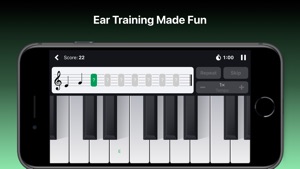
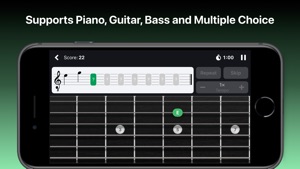
Ensemble Education's ear trainer. Sings-back exercises using the microphone alongside recognition drills, which builds a stronger connection than listening alone.
Good for: players who want to sing what they hear, which is the fastest route to internalising it.
4. Perfect Ear: Music & Rhythm
Perfect Ear: Music & Rhythm
by Crazy Ootka Software AB
4.7 from 1,883 ratingsFreeActively updated
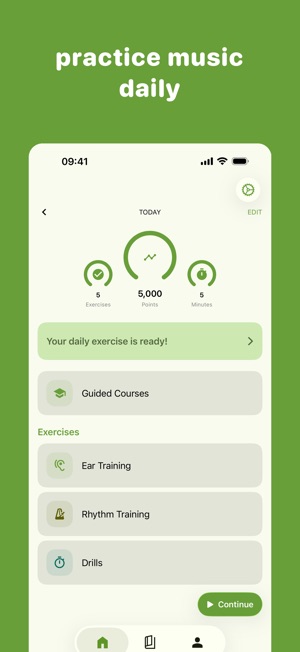
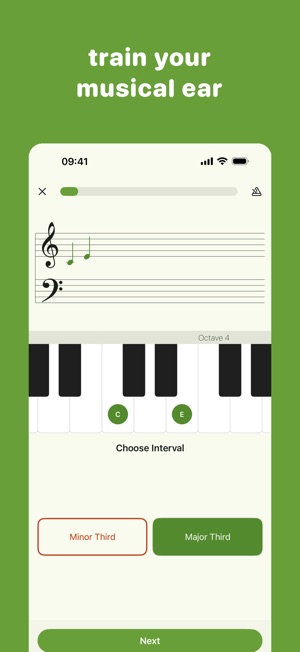
The broadest scope here — intervals, chords, scales, rhythm drills and theory lessons in one app. Breadth costs some polish, but the rhythm modules in particular fill a gap most ear trainers ignore.
Good for: one app covering ear and rhythm together.
5. Tomus
Tomus - music theory tutor
4.9 from 52 ratingsFreeNo update in over a year — last release 2025-05
This is our app — disclosure, not an independent review. We apply the same staleness test to ourselves: 15 months without a release.
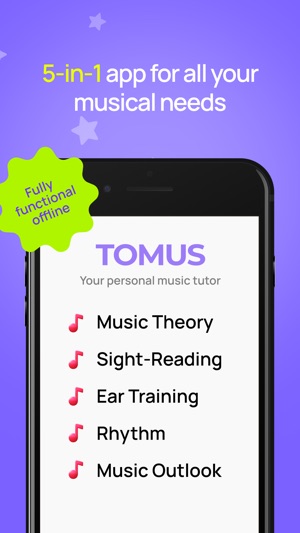
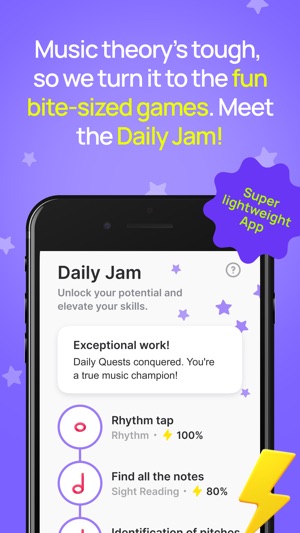
This is our app. Ear training is one of five areas it covers, alongside sight-reading, rhythm, theory and music history. Exercises play a pitch or a passage and ask you to identify it, in short randomised runs with a daily set.
Good for: people who want ear training as part of general musicianship, in a format short enough to keep up daily. Less good for: deep, configurable ear training. Earpeggio and Functional Ear Trainer both go further on that specific axis, and we would point you at them if that is what you want.
Fifty-two ratings is a small number next to Earpeggio's 9,600. We would rather state that than let a high average imply a track record we do not have.
On the maintenance test this page applies to everyone else: Tomus's last App Store release was May 2025. By our own threshold that is "quiet", and several apps ranked below it here have shipped more recently.
6. Sonofield Ear Trainer
Sonofield Ear Trainer
by Sonofield Ear Trainer Education Ltd.
4.9 from 372 ratingsFreeActively updated
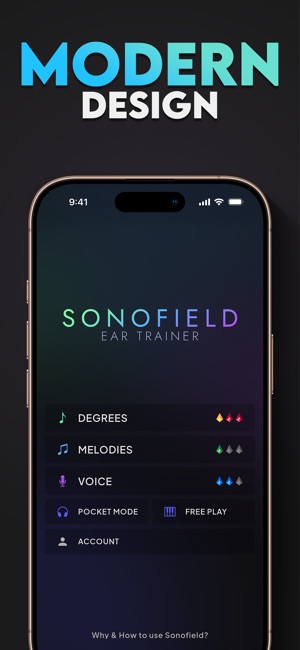
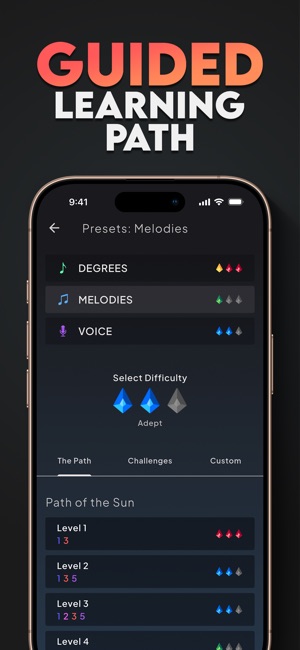
A newer arrival, not in the 2023 version of this list. Well-designed functional and interval training with a clean interface and a generous free tier.
Good for: an alternative to Functional Ear Trainer with a bit more structure.
7. Tenuto
Tenuto
by musictheory.net
4.8 from 655 ratings$4.99Actively updated
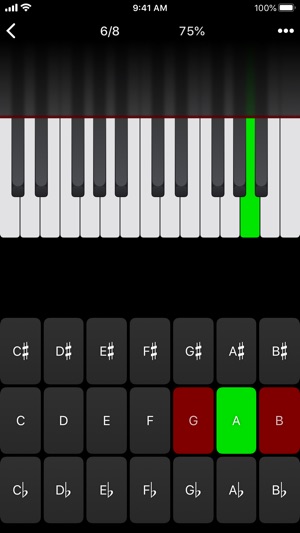
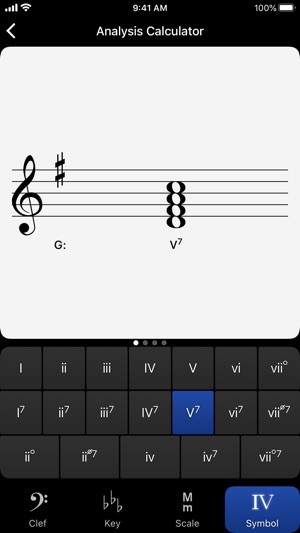
From musictheory.net. Customisable exercises across intervals, chords, scales and key signatures, with no subscription and no ads — which is increasingly rare and worth something.
Good for: students and teachers who want exact control over what is being drilled and would rather pay once.
8. EarMaster
EarMaster - Music Theory
by EarMaster ApS
4.6 from 423 ratingsFreeActively updated
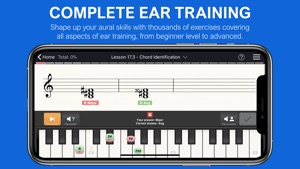
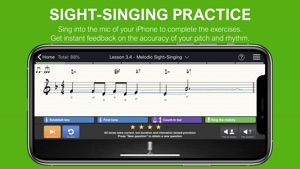
The long-standing desktop ear training suite, now on mobile. The most comprehensive curriculum here, built around structured courses rather than open practice, and used in conservatoire settings.
Good for: systematic study, especially alongside formal training. Less good for: casual five-minute sessions.
9. Complete Ear Trainer
Complete Ear Trainer
by Binary Guilt
4.7 from 196 ratingsFreeActively updated
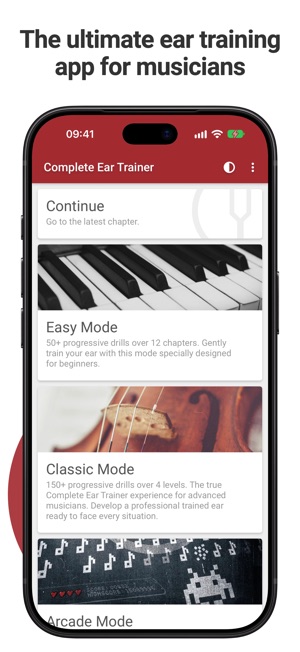
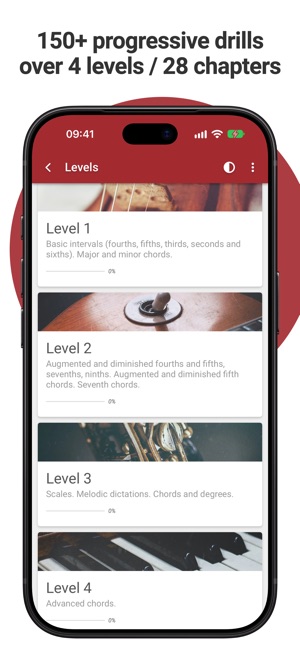
Structured into levels covering intervals, chords, scales and progressions, with a strong emphasis on rhythm training as well.
Good for: learners who want a clear path rather than a settings screen.
10. MyEarTraining
MyEarTraining - Ear Trainer
by myrApps
4.8 from 252 ratingsFreeNo update in over a year — last release 2025-05
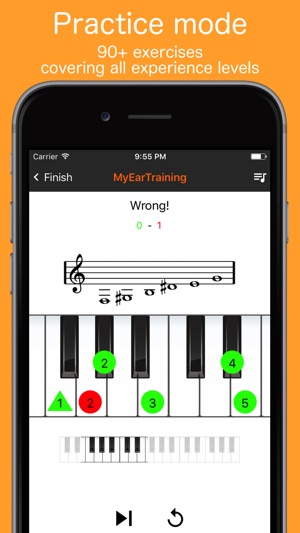
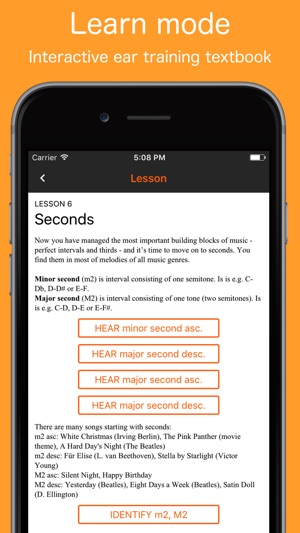
Highly configurable, with custom exercise sets and detailed statistics. Less immediately friendly than Earpeggio, more adjustable once you know what you want.
Good for: targeting one specific weakness for a few weeks.
11. Duolingo Music
Duolingo
4.7 from 5,418,781 ratingsFreeActively updated
Rating, price and release date above cover the whole Duolingo app, across all its courses. Duolingo has published no rating, download or usage figure for the Music course on its own.
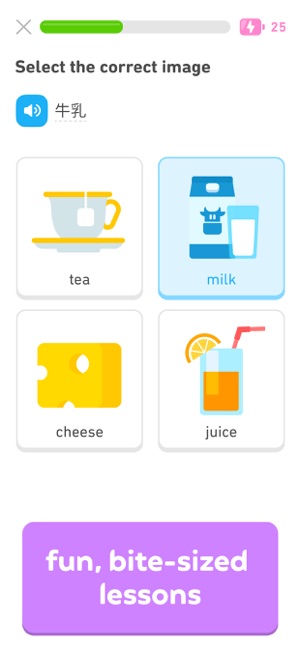
Duolingo Music launched publicly in November 2023, a month after this list first ran. It belongs here because it does contain ear training: according to Duolingo's own launch announcement the lessons cover "pitch, meter, rhythm, and interval", and a first-hand review from February 2024 describes an interval exercise that matches intervals to sound clips.
Why last, and how confident we are. Of this page's four criteria we can only speak to two with any confidence.
Feedback quality is the dimension that decides it, and it is the best-evidenced: Duolingo describes the course as learning "through interacting with game-like exercises" rather than reading "explanations of musical concepts", and the February 2024 review found note values, staff and clef all introduced without explanation. For a skill where knowing why you were wrong is most of the value, that is a real limitation, and it is Duolingo describing its own design rather than us guessing.
Maintenance is the one dimension it wins outright.
Breadth we cannot judge. Interval work exists; whether chord, scale or progression recognition exists we could not establish either way, and finding no mention is not the same as confirming absence. Method we also cannot judge without using it.
So this is a placement, not a measurement. It sits last because the one dimension we can assess it on is the one this page weights most heavily — not because we have compared it feature-for-feature with the ten above.
Not fully evaluated. We have not used the Music course. Its placement rests on Duolingo's own description of the curriculum and on a first-hand review from February 2024, which predates a substantial restructure in February 2025. Whether it covers chords, and how its exercises work today, we do not know.
- Best for
- Absolute beginners who need a habit before they need precision.
- Less good for
- Anyone who wants to know why they were wrong. It corrects but does not explain.
Free to use, with the usual Duolingo caveat: the free tier runs on hearts, so mistakes eventually stop a session until they refill. We have not verified what Duolingo Super costs or exactly which Music content it unlocks.
Also worth knowing about
Aural Wiz — aimed at UK graded exam aural tests. Useful if that is your goal, though it has not been updated since early 2024.
EarForge — a solid interval and chord trainer, last updated December 2024.
What actually produces progress
The app matters far less than the pattern of use.
Daily and short. Five to ten minutes every day will beat an hour once a week, decisively. This is recognition, and recognition is built by frequency.
Randomised. Practising in a fixed order teaches you the order.
Sing it back. Producing a pitch with your voice builds a more durable representation than recognising it does. You do not need to sing well.
Then leave the app. Try to name what you hear in music you are already listening to. That transfer step is where ear training becomes musically useful, and no app will do it for you.
If you want the written groundwork first, start with interval ear training and major and minor intervals.
Was this helpful?
More from Resources
- A field guide to music learning appsSix categories of music app, what each is genuinely good at, and where each one runs out of road.
- The best apps for learning a musical instrumentEleven apps that teach you to play, checked against their current listings rather than their 2023 ones.
- The best sight-reading appsEleven apps for reading notation faster — including which of the old favourites have stopped being maintained.
- How to learn music theoryThe order that works, roughly how long it takes, and where most people get stuck.