Music theory
Intervals, scales, chords, key signatures — named, spelled and recognised.
ChordsiOS app · 4.9 on the App Store
Notes, rhythm, intervals, chords, scales and ear training — trained through short interactive games instead of chapters you forget by Thursday.
The mechanic
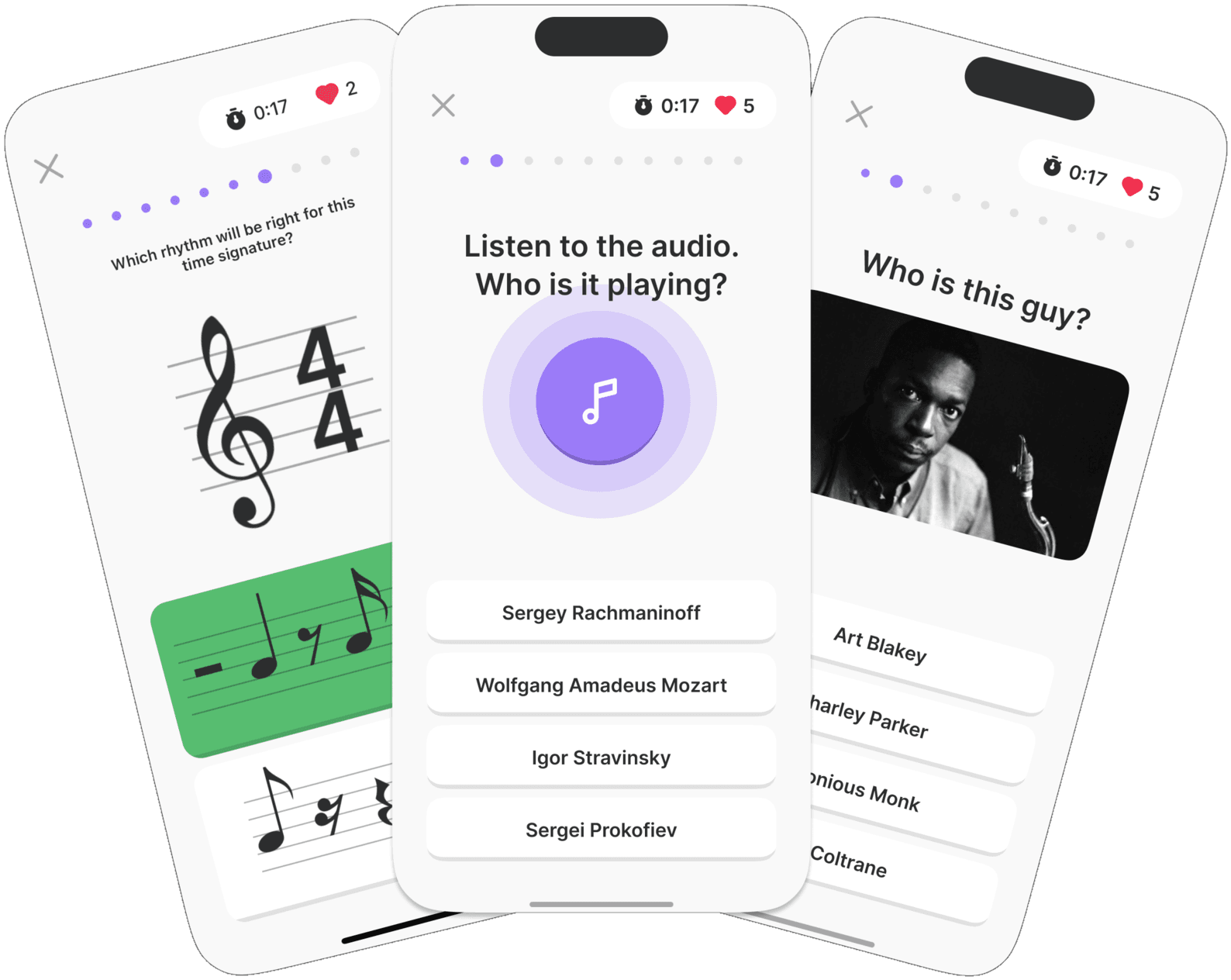
Tomus does not hand you a textbook and hope. It asks you a question, you answer it on the staff or by ear, and it tells you straight away whether you were right.
Each game is a run of ten or so questions with a timer and a few lives. You can finish one while the kettle boils.
Every question shows what the correct answer was, with reference information where it helps. Mistakes are where the learning happens.
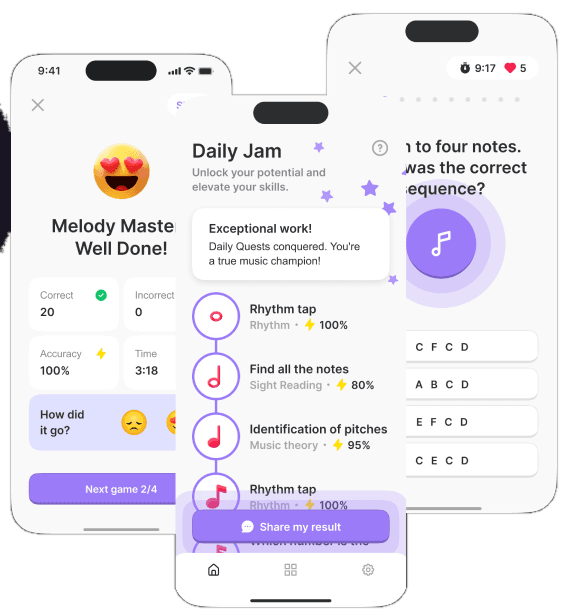
The end-of-game summary reports correct answers, mistakes, accuracy and time — per game and across the five skill areas.
What you train
Tomus splits music theory into the skills that actually behave differently — reading, hearing, counting, and knowing. Each has its own games and its own progress.
Intervals, scales, chords, key signatures — named, spelled and recognised.
ChordsNotes on the staff in treble and bass clef, read at speed rather than counted out.
Note readingPitches, sequences and passages identified by listening, not by looking.
Ear trainingNote values, rests and time signatures — read, matched and completed under time pressure.
RhythmInstruments, records and composers from the medieval period through the romantic.
All topicsThe written side of all of this lives in Learn — concise pages on intervals, scales, chords, keys and the circle of fifths.
Daily Jam
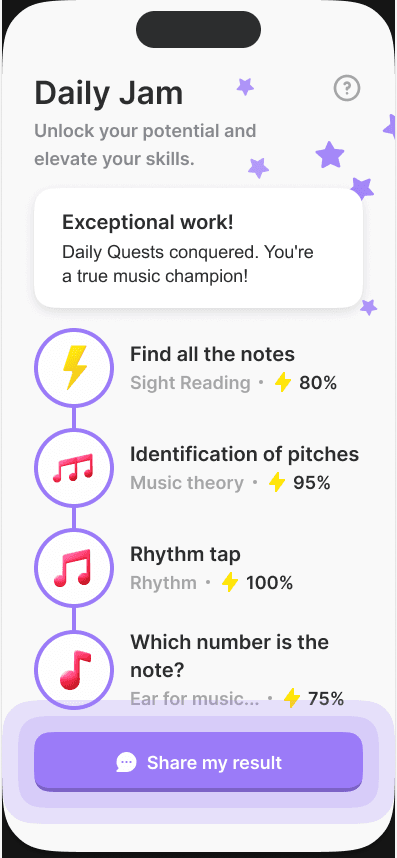
Skills stick through repetition spread over time. Daily Jam is Tomus's version of that: a small set of exercises waiting for you each day, drawn from the three areas that most reward daily practice — ear training, sight-reading and rhythm.
Learn
Games are for practice. When you want the actual explanation — what an interval is, why a key signature has three sharps — it is here, free and without a sign-up wall.
The ideas everything else assumes you already have.
6 lessons
Reading pitch off the page — clefs, staff positions and accidentals.
4 lessons
Duration and pulse — note values, rests, bars and time signatures.
6 lessons
The distance between two notes, and the building block for everything else.
6 lessons
Ordered sets of notes built from fixed interval patterns.
6 lessons
The home note of a piece, and the sharps or flats that come with it.
5 lessons
The map that arranges all twelve keys by how closely related they are.
1 lesson
Notes stacked in thirds — quality, inversions and how chords sit in a key.
6 lessons
What chords do once they are in a key — and why some orders sound finished and others do not.
8 lessons
Hearing what you can already read — intervals, chords and pitch.
4 lessons
82 reference pages: every scale, key, mode, chord and interval.
21 free tools, from a virtual piano to a circle of fifths.
Type a note, chord or idea — F♯ major, Cm7, cadences.
Studying towards an examination? Compare music theory exams and find a preparation guide →
Free tools
Instruments that make a real sound and worksheets you can print with an answer key. No sign-up, nothing to install.
Play with touch, a mouse or your computer keyboard. Chords, octave shift and sustain.
Nine recorded drums and cymbals for touch, mouse or keyboard, with beginner beats to learn step by step.
Strike the bars with touch, a mouse or your keyboard. One or two octaves, note names, and melodies to learn.
Blow into your microphone and press keys: a two-octave melodica your breath controls, with songs to try and share.
Cover the holes and blow into your microphone: a soprano recorder with real fingerings, beginner songs and a chart.
Printable treble and bass clef worksheets at three levels, with answer keys — or practise the same notes online.
Name the key or write the signature, major and minor, treble and bass — with answer keys, or practise online.
Second opinion
We are hardly neutral about our own app. Your assistant already knows what you play, what you have been trying to learn and how much time you actually have — so let it tell you whether this is a fit, and where it isn't.
I'm considering Tomus, an iOS app that teaches music theory through short interactive games — note reading, rhythm, intervals, scales, chords and ear training.

Based on what you know about me, my musical background, the instruments I play and my goals, tell me:
1. whether Tomus is likely to be useful for me
2. which areas I should use it for
3. how to fit it into my practice
4. where Tomus is probably not the right tool for me

Product information: https://tomus.app
ChatGPT, Claude and Grok accept a prompt in the link, so they open with it already written. Gemini and DeepSeek have no such link, so we copy the prompt to your clipboard and open a blank chat for you to paste into. Your conversation stays between you and your assistant — we never see it.
Already convinced? Skip the second opinion.
From the App Store
Real reviews, quoted as written. Tomus currently holds 4.9 from 52 ratings (US App Store, September 2026) — a small, honest number for a small, independent app.
Found the best music app, period! Learning music theory on the go — doesn't get better than this. Big thumbs up!
varochny · Germany
An excellent application for those who are learning music theory from scratch. As someone who knows nothing about music, it's important to me that the learning process is gamified.
olyasaoly · USA
This app takes the mystery out of music theory. Brilliant!
ogyrcheg · Turkey
I've challenged myself with the questions about music history presented in the app, so I feel myself more confident in the music theory now. Thanks to the developers for that!
Lillyme1 · Georgia
A very nice quiz to check and polish your music theory! Keep going to develop the app and implement new features.
GoodBoris · Kazakhstan
Awesome start for the app, hope the developers will go on improving it. Love the idea of short sessions with tests.
KK_2022UK · UK
Very nice app, cool that there's no ads in it. Useful to study music theory, though sometimes there is not enough time to read long quiz questions and long answers.
раталчлчч · USA
Nice app to learn music theory in an entertaining way!
Ксения) · UK
Cool developing quiz, works clearly.
ElenaSlom · Russia
Reviews are shown as published on the App Store and on the previous Tomus website. Star icons are decorative.
FAQ
What the app does, what it costs, and what it is not.
Anything missing? Write to info@tomus.app.
Yes. Questions start from the basics — note names, note values, simple rhythms — and the format is short multiple-choice and tapping games rather than lectures. The App Store listing rates the app 4+, and reviewers who describe themselves as starting from scratch are among the people using it.
No. Every exercise is played on the phone: you read notation, listen to audio, tap rhythms and choose answers. Tomus works alongside an instrument if you have one, but it never requires you to pick one up.
Sight-reading is one of the five areas the app trains. Exercises ask you to name notes on the staff, find notes in a sequence and read rhythms in a given time signature. If you want the written explanations first, start with treble clef notes and note values.
Yes. Ear training is one of the five areas. Exercises play a note or a short passage and ask you to identify what you heard — individual pitches, sequences, and recognition questions built on real recordings.
Yes. Nothing in the app needs a keyboard, a microphone or any external hardware. Headphones help for the listening exercises, that’s all.
The app is free to download, and a Daily Jam is waiting every day — a prepared set of 5 exercises drawn from ear training, sight-reading and rhythm. 3 of those 5 are playable without a subscription, which is enough to keep a daily habit going for nothing.
A premium subscription unlocks the other two and the rest of the library: all 26 games across the five areas, playable as often as you like.
Yes, and not only by awarding levels. There are ten levels, and they change what you are actually shown. Reading games begin in treble clef only; bass clef arrives a few levels in. The range of notes widens as you go, and several games stay locked until you reach the level they were written for.
Your starting point comes from a short test during setup rather than everyone beginning at zero.
Setup asks which of the five areas you care about and gives you a brief test in each, which sets your level per area. You can still play anything from the full game grid at any time — the selection shapes what gets recommended, not what you are allowed to open.
A course moves in one line from lesson one to lesson forty. Tomus is built around 26 short games you can finish in a few minutes each, with a Daily Jam that sets you a fresh handful every day and reports accuracy per exercise afterwards.
It is practice and reinforcement, not a syllabus. That is why the written explanations live here on the site, in Learn, rather than inside the app.
Tomus is free to download, and a premium subscription unlocks the full set of games. On the US App Store the plans are Weekly $0.99, Monthly $2.99, Annual $9.99, Lifetime $69.99. Prices differ by region, and subscriptions are managed and cancelled through your Apple account.
The App Store page always shows the prices that apply to you.
iPhone and iPad, running iOS 15.0 or later. The app is in English and is designed to work offline. There is no Android or web version today.
Yes. Each game ends with a summary — correct answers, mistakes, accuracy and time — and progress is tracked across the five skill areas so you can see which one is lagging.
Free to download, iPhone and iPad, iOS 15.0 or later. Start with the Daily Jam and go from there.